
 English
  русский
  عربى
عربى Home / News / Industry News / Jaw Crusher Components Explained: Structure, Wear Parts, and Material Selection
Jaw Crusher Components Explained: Structure, Wear Parts, and Material Selection
Picture a granite quarry in the middle of a busy production week. The primary jaw crusher has been running for just over three hundred hours since the last liner change, and the operator already sees the warning signs: more slabs on the discharge belt, a closed-side setting that will not hold, and a motor amperage reading that keeps climbing. When the maintenance team locks out the machine and opens the crushing chamber, the fixed jaw plate shows a diagonal wave of metal loss, while the movable jaw is polished smooth across its lower third. Nobody is surprised. The same pattern appears every wear cycle, and every cycle it costs a shift of downtime plus a set of expensive wear parts.
The conclusion is straightforward: a jaw crusher performs exactly as well as the components bolted inside it. The frame, pitman, eccentric shaft, flywheel, bearings, toggle plate, and jaw plates operate as one system. When any one of them underperforms, the machine announces it in product shape, power draw, and availability. Understanding what each component does, how it fails, and how it should be selected is the difference between a crusher that keeps a plant profitable and one that turns into a recurring maintenance problem.
This article walks through every major jaw crusher component, separates the structural parts from the wear parts, explains the material options that actually matter, and gives practical guidance on inspection, replacement, and purchasing. The goal is to help you make better decisions the next time a component needs attention, whether you are a maintenance supervisor, a plant manager, or a procurement specialist.
How a Jaw Crusher Works and Why Components Matter
A jaw crusher is a compression crushing machine. Feed material falls into a wedge-shaped chamber formed by a stationary jaw and a movable jaw. The movable jaw moves toward and away from the stationary jaw in a repeating cycle. On the forward stroke, the rock is squeezed between the two surfaces and fractured; on the return stroke, the broken material falls lower into the chamber, where the cycle repeats.
The motion is not a simple back-and-forth slide. An eccentric shaft, driven through a v-belt from the flywheel and the motor, rotates inside the pitman. The pitman moves up and down, and a pair of toggle plates converts that vertical motion into a rocking, elliptical stroke at the lower end of the movable jaw. The geometry of the toggle mechanism determines the stroke characteristics, and therefore the capacity and the particle shape the machine produces. A machine with a weak or worn component anywhere in that chain will show it in output, power consumption, or premature failure elsewhere.
Every part in that chain has a specific job, and the design of each part affects how well the machine crushes. Some components carry enormous loads for decades; others are engineered to wear out and be replaced on a schedule. The table below summarizes the main components and what they do.
| Component | Category | Primary function |
|---|---|---|
| Crusher body (frame) | Structural | Carries the crushing loads and locates all other components |
| Pitman | Structural | Transfers eccentric shaft motion to the toggle mechanism |
| Eccentric shaft | Structural | Provides the stroke that drives the crushing cycle |
| Flywheel | Structural | Stores rotational energy to smooth the crushing stroke |
| Bearings | Structural | Support the shaft and pitman under heavy radial shock loads |
| Toggle plate | Structural and safety | Transmits the crushing force and breaks when overloaded |
| Retraction spring and tie rod | Structural | Keep the toggle train tight and return the movable jaw |
| Fixed jaw plate | Wear | Provides the stationary crushing surface |
| Movable jaw plate | Wear | Provides the moving crushing surface |
| Side guards (cheek plates) | Wear | Protect the frame side walls from rock abrasion |
Understanding this split is useful because it changes how you think about purchasing. Structural components are infrequent, high-stakes purchases: when a pitman cracks, the machine stops and the replacement bill is large. Wear components are a recurring operating cost. They are consumed predictably, so they deserve a procurement strategy rather than a one-off decision made in a hurry.
The Structural Components That Keep the Crusher Alive
Structural components are the skeleton of the crusher. They are selected for strength, fatigue resistance, and dimensional accuracy, not for abrasion resistance. When they fail, the failure is usually sudden and expensive. A little knowledge of each part helps you understand what your maintenance team is looking at, and what questions to ask when you buy replacements.
Crusher Body (Frame)
The frame is the backbone of the machine. It is normally a heavy steel casting or a welded fabrication, machined on the bearing housings and the jaw mounting surfaces. Its job is to absorb the enormous compressive forces created when rock is crushed, without deflecting enough to change the crusher geometry. The rear end frame, which closes the back of the machine, carries the toggle seat and the setting adjustment mechanism. Even small amounts of frame flex can accelerate bearing wear and produce an inconsistent gap between the jaws.
Frame problems usually show up indirectly: bearing temperatures rise, the setting drifts, or the pitman shows uneven wear. In the field, cracks in the frame are rare but reportable. If a crack is ever found in the frame, stop the crusher immediately and investigate before the damage spreads to the bearing housings or the mounting surfaces.
Pitman
The pitman is the moving arm of the crushing mechanism. It is a large steel casting, mounted on the eccentric shaft and carrying the bearing that connects it to the movable jaw. On every rotation of the eccentric, the pitman lifts and then drives the toggles outward, forcing the movable jaw against the rock. It is one of the most heavily fatigue-loaded parts in the machine.
The classic pitman failure is cracking at the corners of the bearing housing or along a sharp radius, where stress concentrates. Most cracks start small and are only found during a scheduled inspection or when a bearing overheats. If you are buying a used crusher or inspecting an existing one, the pitman deserves the closest attention. Check for grinding marks made to repair a crack, weld repairs, and any sign of distortion around the toggle seats.
Eccentric Shaft
The eccentric shaft is the heart of the drive system. It is usually forged from alloy steel and machined to a precise eccentric geometry. As the shaft rotates, the throw of the eccentric determines the amplitude of the swinging jaw stroke. A shaft that is correctly specified produces a consistent stroke; a bent or worn shaft produces a stroke that varies from one end of the jaw to the other.
Shafts rarely wear out from normal crushing. They do, however, suffer from fatigue cracks, bent journals after a major impact, and scoring from contaminated bearings. Because the shaft is expensive and difficult to replace, bearing maintenance is the most important protective measure you can take. Monitor lubrication intervals, check bearing temperatures, and keep contaminants away from the housings.
Flywheel
The flywheel stores rotational energy and releases it during the crushing stroke, when the motor alone would not provide enough torque. In practical terms, the flywheel smooths the power demand and prevents the crusher from stalling on hard rock. One side of the flywheel often carries the v-belt pulley for the drive.
Flywheel problems are usually mechanical rather than metallurgical: a loose hub, a cracked spoke, or excessive runout after a violent overload. A flywheel that appears to rotate unevenly may be pointing to a problem elsewhere, such as a failing bearing or a wrong-speed drive arrangement. Vibration readings on the flywheel over time are a simple and effective diagnostic.
Bearings
Jaw crushers rely on large spherical roller bearings to support the eccentric shaft in the frame and in the pitman. These bearings are selected for very high radial loads and some misalignment tolerance. Their operating conditions are brutal: heavy shock loads, contamination from dust around the machine, and heat from continuous operation.
The most common bearing failures in jaw crushers are caused by inadequate lubrication, water or dust entering the housing, and loss of internal clearance. A bearing that fails can seize the shaft, damage the pitman, and put the crusher down for days. Bearing maintenance is not a side task; it is the single most important reliability program on the machine.
Toggle Plate and Toggle Seats
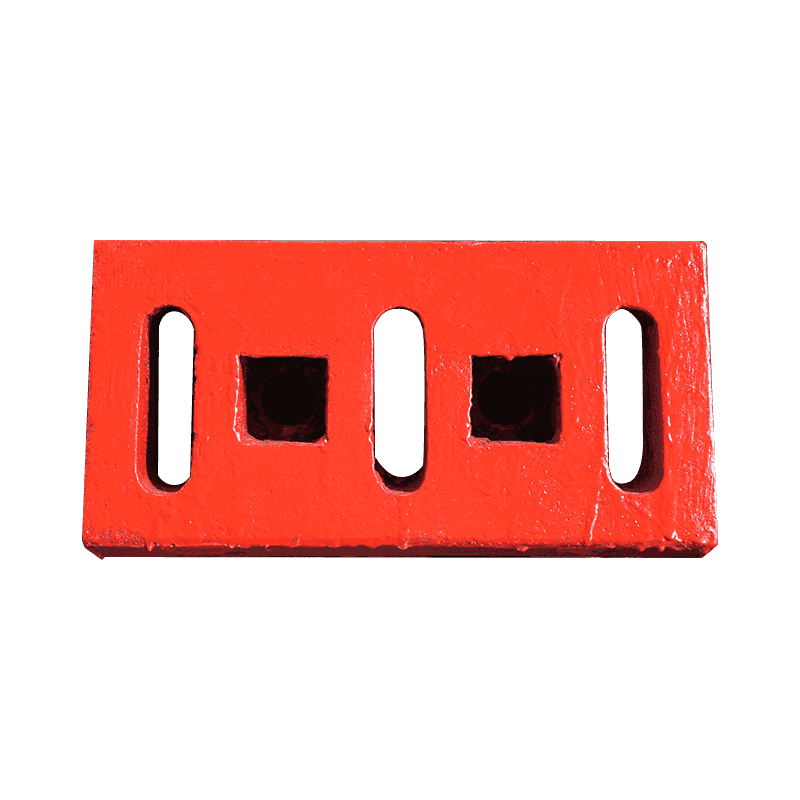
The toggle plate is a deceptively simple looking part that performs two jobs at once. It transmits the compressive force from the pitman to the movable jaw, and it acts as the crusher's overload safety device. Because it is designed to break before more expensive components are damaged, an uncrushable piece of metal in the chamber will fracture the toggle plate instead of destroying the pitman or the frame.
Because of that safety role, the toggle plate is intentionally cast from a steel grade that is not as tough as the other structural components. That is not a manufacturing flaw; it is the design intent. If the toggle plate starts to buckle or crack under normal operation, the cause is usually an incorrect setting, excessive fines in the feed, or a worn toggle seat.
Retraction Spring and Tie Rod
The retraction assembly keeps the toggle train tight. A set of springs or hydraulic cylinders, connected through a tie rod, pulls the movable jaw away from the toggle plate after each forward stroke. This ensures the toggle plates remain seated and the moving jaw returns to the open position consistently.
If the retraction spring loses tension or the tie rod is damaged, the toggle plate can rattle, shift, or even jump out of its seat. The symptom is a knocking sound in the lower part of the crusher and a loss of setting stability. This is a quick check during weekly inspections and an easy adjustment for the maintenance team.
Setting Adjustment Mechanism
The closed-side setting controls the finished product size. Older crushers adjust the setting by inserting longer or shorter toggle plates or by moving wedges behind the rear toggle seat. Modern machines use hydraulic cylinders that shift the toggle seat to change the gap without manual shimming.
No matter which system your crusher uses, the setting mechanism must be checked regularly. A crusher that runs with a drifting setting creates oversize product, reduces downstream performance, and wastes energy. Keep the adjustment mechanism clean, lubricated, and protected from the dust that tends to build up around it.
Structural components age like any piece of heavy equipment. The frame and pitman do not wear out in the same way as a jaw plate, but they accumulate fatigue, small cracks, and loosened fits over years of service. A scheduled inspection that includes cracks detection on the pitman and frame, torque checks on mounting bolts, and alignment measurements will catch the small problems before they become catastrophic failures.
Wear Components: The Parts That Take the Punishment
Wear components are the parts that actually touch the rock. They are designed to be consumed, and they are the reason every jaw crusher needs regular liner changes. The right wear component, made from the right material, protects the frame, keeps the crushing geometry stable, and delivers the lowest cost per ton.
Fixed Jaw Plate
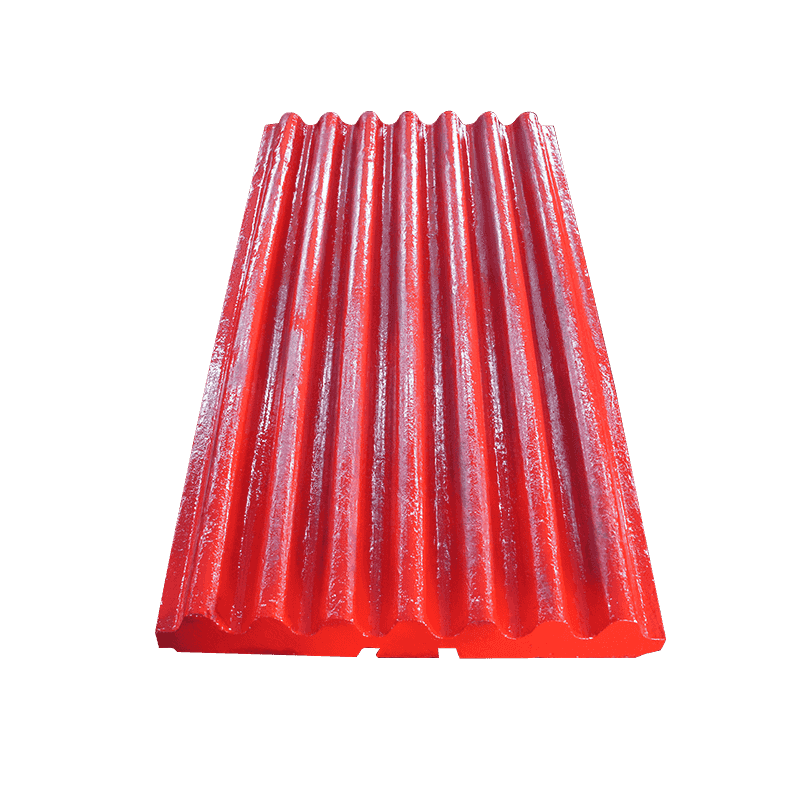
The fixed jaw plate sits on the stationary jaw face and forms the rigid side of the crushing chamber. It carries the upper part of the crushing forces and is usually supported by a wedge system that locks it against the frame. The tooth profile is designed to catch the feed, break it on the first bite, and direct it down into the chamber. Profiles range from deep corrugated teeth for coarse feed to fine ribs for smaller feed and higher reduction requirements. A profile that does not match the application will wear unevenly and let material slide instead of break.
Wear on the fixed jaw plate is not uniform. The lower section sees more sliding wear than the upper section, because material moving down the chamber is already smaller and more abrasive. Many operations rotate jaw plates to even out wear before replacement. A plate that is flipped or rotated at the right time can deliver dramatically more service life, and that simple practice often reduces annual wear part cost by twenty to thirty percent.
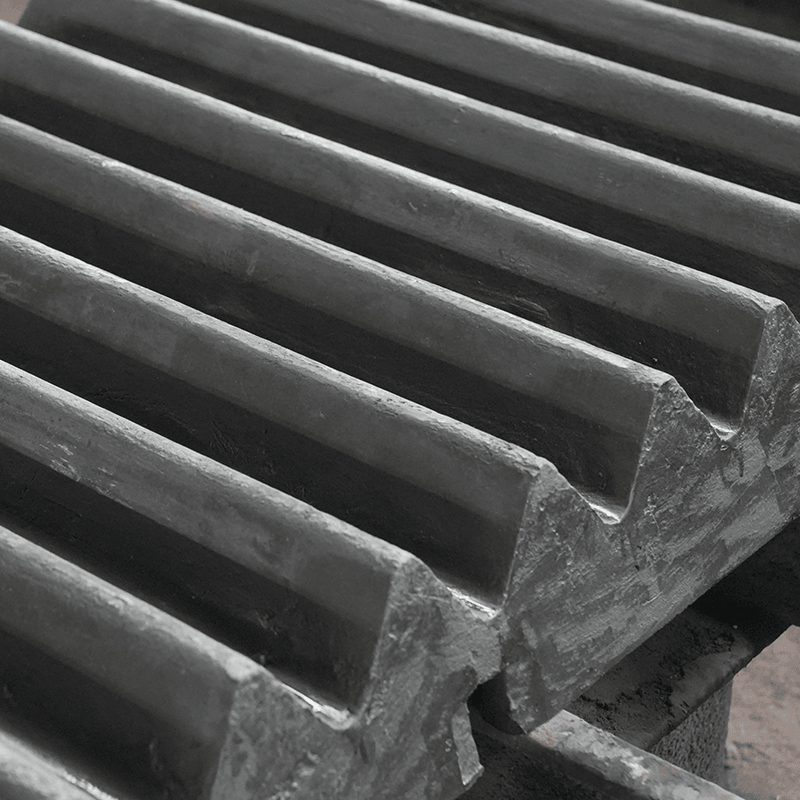 High Manganese Steel Fixed Jaw Plate for Jaw CrusherThis fixed jaw plate is paired with the movable plate to crush rock. Its lower section endures sliding wear, making rotation and proper alloy choice important for extended service life and reduced wear costs.View Product →
Movable Jaw Plate
The movable jaw plate is mounted on the movable jaw, which is driven by the toggle mechanism. The two plates are usually slightly different in tooth profile, because they work differently. The movable jaw swings toward the fixed jaw, so it is the plate whose movement controls the compression cycle. It also receives the highest impact loads, which matters for material selection. A movable plate made from a material that cannot absorb impact may crack on the first day it meets a block of hard basalt.
Because the movable jaw plate is hit harder than the fixed plate, it benefits from a material that work-hardens under impact, and it is often the first plate to show fatigue or breakage if the wrong alloy is installed. If movable plates are replaced more frequently than fixed ones, that is normal in many applications. If both plates wear out before their expected life, the cause is more likely a poor fit, an incorrect tooth profile, or a material mismatch rather than a single quality defect.
 High Manganese Steel Movable Jaw Plate for Jaw CrusherThe movable jaw plate absorbs heavy impact as it swings, so work-hardening material is essential. It typically wears faster than the fixed plate and benefits from careful alloy selection to prevent premature cracking.View Product →
Side Guards (Cheek Plates)
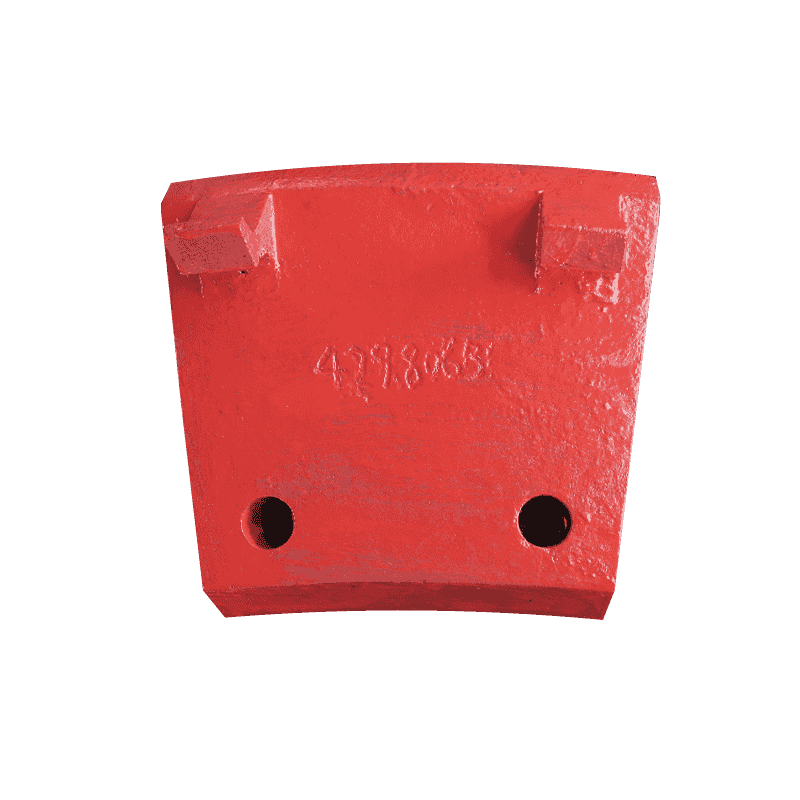
The side guards, sometimes called cheek plates, protect the frame side walls between the fixed and movable jaws. They are smaller than the jaw plates but still crucial. If a side guard is missing, worn through, or badly fitted, the frame can be abraded by rock sliding along the chamber, and frame repair is far more expensive than the side guard would have been.
Side guards also influence the crushing chamber geometry. Worn cheek plates widen the chamber slightly, which changes the material flow and can reduce the efficiency of the machine. Check them at every liner change, and replace them before they wear into the frame mounting points. Like the jaw plates, side guards are normally cast in high manganese steel so they can work-harden under the impacts inside the chamber.
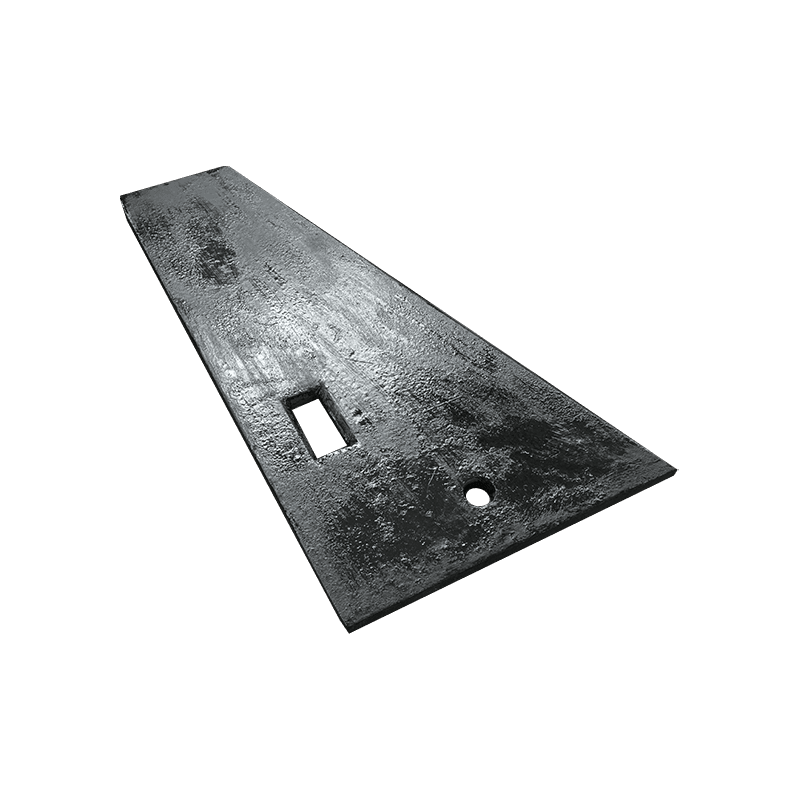 High Manganese Steel Side Guard for Jaw CrusherThese cheek plates protect the crusher frame from abrasion and maintain chamber geometry. Replacing them before heavy wear avoids expensive frame damage and keeps crushing efficiency stable.View Product →
The Toggle Plate as a Wear and Safety Part
The toggle plate deserves a second look in any discussion of wear, because it is the closest thing the crusher has to a fuse. It is designed to break under an uncrushable load, protecting the pitman, shaft, and frame from total destruction. Some plants carry a spare toggle plate for exactly this reason, and replacing a broken toggle is far cheaper than rebuilding a damaged pitman.
Beyond its safety role, the toggle plate is a sliding contact part that wears at its end sockets. If the seats on the toggle plate and the toggle block become worn, the geometry of the stroke changes, capacity drops, and the plate can start to gall or crack. Inspect the contact surfaces at every scheduled stop, and replace the plate or the seats before the wear affects the setting.
Material Selection for Jaw Crusher Wear Parts
If the geometry of a jaw plate decides how well it crushes, the metallurgy decides how long it lasts. The material in a jaw plate must survive three things: high compressive stress, repeated impact, and sliding abrasion. Different materials solve those three demands in different ways, and the choice has a direct effect on your cost per ton.
High Manganese Steel: The Work-Hardening Standard
High manganese steel, also known as Hadfield steel, is the traditional material for jaw crusher wear parts and remains the standard for a reason. Its chemistry is typically around 12 to 14 percent manganese and 1.0 to 1.4 percent carbon. In the as-cast state the material is austenitic and relatively soft, with a hardness of about 180 to 220 HB. Under the severe impact and pressure of crushing, the surface transforms and work-hardens to a much higher hardness, often in the range of 400 to 550 HB, while the interior stays tough and crack-resistant.
That combination is exactly what a jaw crusher demands. The surface resists penetration and gouging, while the body absorbs the shock of the stroke without fracturing. If the feed is hard, coarse, and high-impact, high manganese steel is usually the right answer. A practical guide to high manganese steel castings for jaw and impact crushers covers the metallurgy, grades, and application details more thoroughly.
High-Chromium Iron and Composite Options
High-chromium iron is known for extreme hardness, typically starting at 600 HB or more, but it is brittle. In a jaw crusher, where rocks are slammed between two plates, high-chromium iron can chip and crack unless the application creates relatively low impact conditions. In practice, high-chromium iron appears more often in impact crusher blow bars and in certain grinding mill parts than in jaw plates. The same is true for many composite designs that combine a manganese steel body with a high-hardness surface layer.
Composite and layered designs try to combine both worlds: a manganese steel body with a high-hardness surface layer or embedded cast inserts. These products can improve wear life in specific abrasive ores, but they also cost more and require careful matching to the application. A composite plate that fails by cracking can cost far more in downtime than it saved in extended life. The decision should come from operating data, not from a supplier brochure.
How to Choose the Right Material
The correct material depends on feed size, rock abrasiveness, compressive strength, moisture, and the crusher's stroke and speed. As a rule, high manganese steel suits coarse, high-impact feeds; high-chromium or composite materials suit fine, abrasive, low-impact conditions. Most primary jaw crushers operate in the first category.
The table below compares the main material families for jaw crusher wear components.
| Material | Initial hardness | Work-hardened hardness | Toughness | Best suited for |
|---|---|---|---|---|
| High manganese steel (12-14% Mn) | 180-220 HB | 400-550 HB | Very high | Coarse, high-impact feed; standard primary crushing |
| High-chromium iron | 550-700 HB | Similar | Low | Low-impact, high-abrasion fines; specific secondary uses |
| Low-alloy steel | 250-400 HB | Similar | High | Medium-impact conditions where manganese work-hardening does not develop fully |
| Composite / embedded inserts | Varies | Varies | Medium | Special abrasive ores; requires application review |
The numbers matter because they explain why a well-manufactured manganese plate can outperform an exotic alloy in a jaw crusher. The material works with the machine's impact rather than against it. If you are selecting a replacement plate, ask for the chemical composition and heat treatment details, and compare them with the original specification rather than buying on price alone.
What Failure Modes Tell You About Component Health
Every unexpected wear pattern or breakage is information. Experienced maintenance teams treat cracks, grooves, and breakages as a diagnostic signal rather than just bad luck. The table below lists the most common jaw crusher component problems, their usual causes, and the practical action that should follow.
| Failure mode | Likely cause | Practical response |
|---|---|---|
| Premature wear of lower jaw plate | Setting too small, fine feed, or wrong material for the ore | Adjust closed-side setting, review feed grading, verify material grade |
| Wavy or grooved wear profile | Contaminated feed, hard lumps, or worn tooth profile | Inspect feed, reverse or rotate plates, check profile match |
| Jaw plate cracking or breakage | Impact overload, insufficient support, or low-toughness material | Check backing and wedges, confirm material toughness, remove tramp metal protection |
| Toggle plate fracturing repeatedly | Overload caused by uncrushable objects or excessive setting force | Inspect feed for metal, adjust setting, check toggle seat condition |
| Bearing overheating | Contamination, lubricant failure, or loss of clearance | Check seals, renew grease, monitor temperature trend |
| Pitman crack | Fatigue from heavy duty cycles or prior damage | Stop the crusher, carry out a full structural inspection |
| Eccentric shaft scoring or bending | Bearing failure or major impact | Inspect shaft journals, replace bearing, repair seal condition |
| Setting drift | Worn toggle seats, loose wedges, or failing retraction spring | Tighten wedges, replace worn seats, restore spring tension |
Notice how many of these failures trace back to feed control and maintenance fundamentals. A crusher that is fed correctly, lubricated on schedule, and inspected regularly will reveal the few genuine component problems that remain, rather than hiding them among a pile of self-inflicted issues. The failure mode table also helps when you talk to a supplier: describing the exact pattern you see makes it easier for a foundry to recommend the correct material or profile.
Component Inspection and Replacement Guidelines
Jaw crusher components should be inspected at planned stops, not only after a problem appears. A structured inspection takes a short time and catches most issues before they turn into unplanned downtime. The following checks represent the minimum for a practical inspection program.
- Measure the wear profile of both jaw plates against the original tooth profile. Compare the current wear to the previous measurement to calculate the remaining life.
- Check the closed-side setting at several points across the jaw width. A setting that varies along the width indicates frame flex, worn seats, or a worn toggle train.
- Inspect the side guards for holes, cracking, or wear around the bolt holes. A loose side guard is dangerous because it can fall into the chamber during operation.
- Examine the toggle plate seats and the toggle block for brinelling, galling, or loose fit. These contact surfaces should be smooth and free of deformation.
- Confirm the retraction spring tension and the condition of the tie rod. A loose spring assembly causes knocking and unstable settings.
- Use a temperature gun on the bearings at the end of a shift and record the readings. Rising temperatures over consecutive days are more informative than a single measurement.
- Look for cracks in the pitman and frame with the same attention you give to the wear parts, especially around the radii of the bearing housings.
- Verify the tightness of the wedges that lock the jaw plates. Loose plates can shift or break under load, and a loose wedge is the first thing to check when a plate cracks.
For replacement, the critical rule is to match the original component's dimensions and the original material specification. Jaw plates are not interchangeable by brand alone. The tooth profile, mounting holes, wedge angles, and the distance between the wear surface and the mounting face all affect how the plate sits in the chamber. A replacement that is close but not exact will shift, crack, or change the crushing performance even if it bolts on without problems.
It is also worth establishing a rotation program. If the wear pattern permits, rotate or flip the plates at half their expected life. This simple practice can extend the total service life of a set by twenty to thirty percent, which has a direct effect on operating cost. Keep records of each set: hours run, tons crushed, and final wear profile. That history becomes the basis for predicting the next change-out and for deciding whether a different material grade is worth trying.
Buying Jaw Crusher Components: What to Verify Before You Order
Purchasing is where most of the avoidable component problems actually start. A set of jaw plates that is slightly off-specification, or a toggle plate made from the wrong steel, looks identical in a catalog photo and creates expensive problems once installed. The following checks reduce the risk of a bad purchase.
First, verify the casting quality and chemical composition. A reputable wear parts foundry should be willing to provide the chemical analysis of the heat used to produce your components. For high manganese steel, the manufacturer should confirm the manganese and carbon content, as well as the heat treatment that restores the austenitic structure. Without proper heat treatment, manganese steel remains brittle and will crack on the first hard stone.
Second, check the dimensional tolerances, not just the overall length and width. The critical dimensions include the mounting hole pattern, the dovetail or wedge surfaces, and the distance from the tooth tip to the back face. These are the dimensions that are difficult for a buyer to measure after installation and the ones that cause the most trouble when they are wrong. A simple set of calipers and a drawing supplied by the OEM or the casting manufacturer are enough to catch most mismatches.
Third, ask about batch-to-batch consistency. Wear parts are a recurring consumable, so the second set you order matters just as much as the first. A foundry with stable casting and heat-treatment processes delivers the same performance from one order to the next. As explained in our look at what makes high manganese steel castings essential for jaw crushers, the consistency of the material structure is what keeps every replacement set performing like the last. Ask the supplier how often they test hardness and composition, and whether they can show results for the actual batch you are buying.
Fourth, think about the full package, not just the wear plates. Spare toggle plates, side guards, wedges, and the small items in the retraction assembly are inexpensive compared with a pitman or a shaft, and they protect the expensive parts. If a supplier can provide the complete set for your crusher model, you simplify your stocking and reduce the risk of mixing components from different sources. One conversation with a casting specialist is often faster and safer than shopping each part separately.
Finally, watch delivery lead times. Wear life is predictable, so the professional approach is to schedule replacements rather than react to them. Know your expected wear life in hours, order the replacement set well before the current one reaches its limit, and keep critical spares such as toggle plates in stock. A short unplanned shutdown caused by a missing part usually costs more than the part itself, so a reliable supply partner is part of the value of any purchase.
Building a Smarter Component Strategy
Jaw crusher components are not a collection of unrelated spare parts. They are a system, and the best operations treat them that way. They keep the structural components healthy through discipline and inspection, they choose wear materials based on the actual feed and crushing conditions, and they buy from suppliers who understand the metallurgy behind the product. That approach keeps the crusher available, the product consistent, and the cost per ton under control.
The questions that matter are simple. Does the supplier cast the part, heat-treat it, and test it in-house? Can they document the chemical composition and hardness? Do their fixed jaw plates, movable jaw plates, and side guards match the original profile of your crusher? A foundry that takes casting quality seriously answers those questions with confidence rather than vague promises.
At the end of the day, the performance of a jaw crusher is measured in tons per hour, cost per ton, and availability. The components decide all three. Invest the time to understand them, verify them, and schedule their maintenance, and the crusher will deliver what the nameplate promises for years to come.
Previous Post
No previous article
Next Post
Commercial 50% Cone Crusher Spare Parts: When to Buy at the Right Wear Point
Related Products

-
- Phone:
-
+86 182 6058 7168
+86 (0)513 6890 5666
-
- Email:
- [email protected]
-
- Address:
- Wanghao Industrial Park, Haimen City, Nantong City, Jiangsu Province, China
-
- Media:

