
 English
  русский
  عربى
عربى High Manganese Steel Castings: Jaw & Impact Crusher Guide
High Manganese Steel Castings are the workhorse wear materials of the crushing and mineral processing industries. Cast from austenitic manganese steel with manganese content typically between 11 and 14 percent, these components deliver a combination of properties that no other commercially available alloy can match for impact intensive crushing applications: they are relatively soft when first installed, yet they harden dramatically at the surface when subjected to repeated impact loading, a phenomenon known as work hardening or strain induced transformation. This surface hardening occurs during operation rather than before installation, meaning the material continuously regenerates its hard wearing surface throughout its service life under the correct operating conditions.
The direct conclusion for anyone specifying High Manganese Steel Castings is this: the alloy is the standard and correct material for Jaw Crusher High Manganese Steel Castings and Impact Crusher High Manganese Steel Castings because the impact stress conditions in both crusher types are precisely what activates the work hardening mechanism that gives the material its exceptional wear life. In applications with low impact and predominantly abrasive wear, other materials may outperform high manganese steel, but in jaw and impact crushers where every crushing cycle delivers significant compressive and impact force to the wear parts, high manganese steel castings are the established specification for good technical reason. This article covers the metallurgy, manufacturing requirements, and application specific performance considerations for jaw and impact crusher components in full depth.
The Metallurgy of High Manganese Steel: Why Work Hardening Matters
Austenitic manganese steel was first developed by Sir Robert Hadfield in 1882 and remains commercially known as Hadfield steel. Its defining characteristic is a fully austenitic microstructure retained at room temperature through the combination of high carbon content (typically 1.0 to 1.4 percent) and high manganese content (11 to 14 percent), which together suppress the martensitic transformation that would normally occur in carbon steel on cooling from austenite. The as cast material has a hardness of approximately 170 to 210 Brinell, which is softer than many tool steels and alloy wear steels, but this initial softness is accompanied by exceptional toughness: the material can absorb large impact forces without fracturing because the austenitic matrix deforms plastically rather than cracking.
The critical work hardening mechanism: when high manganese steel is subjected to compressive impact stress exceeding approximately 300 to 500 MPa, the austenite at and near the stressed surface transforms to martensite through a strain induced phase transformation, raising the surface hardness from approximately 200 Brinell to 450 to 550 Brinell. This transformed surface is hard and wear resistant, while the underlying austenitic core remains tough and fracture resistant. The practical result is a component that develops a hard wearing surface in service while maintaining the impact toughness necessary to survive the shock loads of the crushing process without shattering.
Manganese and Carbon Content Grades
High Manganese Steel Castings for crusher applications are produced in several standard grades with different manganese and carbon contents optimized for different crushing duties:
- Standard Mn13 grade (ASTM A128 Grade B 2): Approximately 1.0 to 1.4 percent carbon and 11 to 14 percent manganese. The most widely used grade for jaw and impact crusher liners in medium hard to hard rock applications. Provides good balance of work hardening rate and toughness.
- Modified Mn18 grade (high manganese): Approximately 1.0 to 1.3 percent carbon and 16 to 19 percent manganese. Higher manganese content increases austenite stability, improving toughness but reducing the work hardening rate slightly. Preferred for large crusher components where fracture risk from excessive impact is higher and wear life must be extended through greater depth of work hardened layer.
- Chrome modified manganese steel: Standard Mn13 composition with the addition of 1.5 to 2.5 percent chromium. Chromium addition improves abrasion resistance at some cost to toughness, making chrome modified grades suitable for crusher applications involving both high impact and significant abrasive wear from siliceous rock or quartzite.
Jaw Crusher High Manganese Steel Castings: Specification and Performance
A jaw crusher operates by compressing rock between a fixed jaw plate and a movable jaw plate (the swing jaw), with the two jaw plates converging at the bottom of the crushing chamber and diverging at the top. The rock is nipped between the jaws and fractured by compressive force as the swing jaw drives forward. The jaw plates are the primary wear components in this system and are the most important application for Jaw Crusher High Manganese Steel Castings.
Jaw Plate Design and Profile Considerations
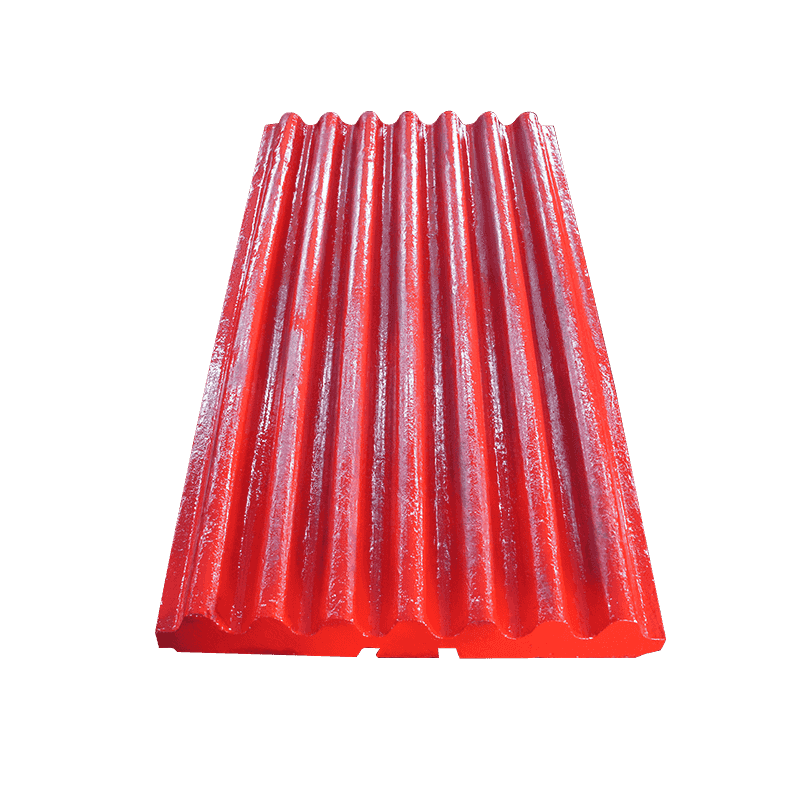
Jaw plates for large jaw crushers are cast as single pieces or in multiple sections depending on the crusher size and the foundry's casting capability. The working surface of the jaw plate is corrugated with ridges that concentrate compressive stress and assist in rock fracture. The corrugation profile (ridge height, pitch, and angle) is optimized by crusher manufacturers for the specific rock type and size reduction ratio of the application. For hard, competent rock (granite, basalt, gneiss) with a compressive strength above 150 MPa, jaw plate wear life in high manganese steel typically ranges from 50,000 to 200,000 tonnes of processed material, depending on rock abrasivity index, crusher feed gradation, and crusher operating parameters.
Heat Treatment Requirements for Jaw Plates
As cast high manganese steel contains carbide precipitates at grain boundaries that result from slow cooling through the carbide precipitation temperature range during solidification. These carbides embrittle the material and must be dissolved before the casting is put into service. The solution heat treatment process involves heating the casting to 1,020 to 1,100 degrees Celsius for a sufficient time to dissolve all carbides, then quenching rapidly in water to preserve the fully austenitic structure. Jaw Crusher High Manganese Steel Castings that have not been properly solution heat treated will fail by brittle fracture rather than by gradual wear, often within the first hours of service in a demanding crusher application. Verification of the heat treatment through Brinell hardness measurement and microstructural examination is essential quality control for this product.
Impact Crusher High Manganese Steel Castings: Different Stress Conditions, Different Design Priorities
An impact crusher fractures rock by high velocity impact rather than by compressive force. In a horizontal shaft impact (HSI) crusher, a rotor fitted with blow bars rotates at high speed and strikes rock fed into the crushing chamber, accelerating it into impact plates (also called curtains or aprons) where it fractures on contact. In a vertical shaft impact (VSI) crusher, rock is fed into a high speed rotor and propelled centrifugally against a rock lined or anvil lined outer chamber. The stress conditions imposed on wear parts in impact crushers differ fundamentally from those in jaw crushers, with higher strain rates and different directions of force application.
Blow Bars: The Most Critical Impact Crusher Component
Blow bars are the primary wear components in horizontal shaft impact crushers, mounted in slots on the rotor and striking incoming rock at the rotor's peripheral velocity (typically 25 to 45 meters per second in primary impactors). The blow bar must simultaneously resist abrasive wear from rock contact and absorb the high energy impact shock of each rock bar collision without fracturing. High Manganese Steel Castings are the standard specification for blow bars in primary and secondary impact crushers processing hard rock because the high velocity impacts provide the stress conditions required for effective work hardening. Blow bar service life in hard limestone processing is typically 200 to 600 tonnes of rock per kilogram of blow bar weight, while processing harder rock such as basalt or granite may reduce this to 50 to 200 tonnes per kilogram, reflecting the higher abrasivity and impact severity of harder rock types.
Impact Plates and Breaker Plates
Impact plates (also known as aprons or curtains) receive rock flung from the rotor and must absorb repeated high energy impacts over their service life. These components are also commonly supplied as Impact Crusher High Manganese Steel Castings, though in some lower impact applications they may be produced from Cr Mo white iron which offers higher abrasion resistance at the cost of reduced toughness. The choice between high manganese steel and white iron for impact plates depends on the specific impact energy levels in the crusher: where impacts are severe, manganese steel's superior fracture toughness is essential; where impacts are moderate and abrasion dominates, white iron may offer longer service life.
Comparing High Manganese Steel Castings for Jaw and Impact Crushers
| Factor | Jaw Crusher High Manganese Steel Castings | Impact Crusher High Manganese Steel Castings |
|---|---|---|
| Primary wear components | Fixed jaw plate, movable jaw plate, cheek plates | Blow bars, impact plates, breaker plates, rotor tips |
| Stress mechanism | Compressive nipping force, cyclic loading | High velocity impact, tensile and shear stress |
| Preferred grade | Mn13 standard; Mn18 for large crushers | Mn13 for hard rock; Mn18 for primary impactors |
| Work hardening effectiveness | High: consistent compressive stress activates hardening | Very high: high velocity impact is highly effective for work hardening |
| Typical surface hardness in service | 450 to 520 Brinell at wear surface | 480 to 550 Brinell at blow bar face |
| Heat treatment requirement | Solution anneal at 1,020 to 1,100 degrees C, water quench essential | Same requirement; critical for fracture resistance of blow bars |
Quality Control and Procurement Considerations for High Manganese Steel Castings
The performance of High Manganese Steel Castings in crusher applications is highly dependent on the quality of the casting and heat treatment process, making supplier selection and incoming inspection critically important. The following quality criteria should be specified and verified for all High Manganese Steel Castings used in jaw and impact crusher applications:
- Chemical composition verification. Spectrometric analysis should confirm that manganese content is within the specified range (11 to 14 percent for Mn13, 16 to 19 percent for Mn18) and that carbon, silicon, phosphorus, and sulfur are within the grade specification. Excessive phosphorus above 0.07 percent and sulfur above 0.05 percent embrittle the steel and must be controlled.
- Heat treatment verification by hardness testing. As quenched hardness should be in the range of 170 to 220 Brinell. Values significantly above this range indicate incomplete solution treatment (residual carbides) or error in alloy composition. Values below 160 Brinell may indicate solution temperature was too high, causing grain growth that reduces toughness.
- Dimensional accuracy and surface finish. Casting dimensions should be verified against the manufacturer's drawing with appropriate tolerances. Jaw plates and blow bars must fit their respective mounting systems correctly to ensure uniform load distribution and prevent premature failure from stress concentration at mounting points.
- Freedom from harmful casting defects. Shrinkage porosity, cracks, and significant inclusions in the wear surface or mounting zone are cause for rejection. Surface cracks can be detected by magnetic particle inspection or dye penetrant testing; internal defects require ultrasonic testing or radiographic inspection in critical applications.
High Manganese Steel Castings for jaw and impact crushers represent a well established and technically validated wear material solution that has served the quarrying, mining, and aggregate production industries for well over a century. The material's unique self hardening mechanism under impact conditions, combined with its fracture resistant toughness, makes it genuinely difficult to improve upon for the specific loading conditions of these crusher types. The key to realizing its full performance potential lies in correct alloy grade selection for the specific rock type and crusher duty, adherence to solution heat treatment requirements, and rigorous incoming quality inspection that verifies both composition and heat treatment adequacy before the castings enter service.
Previous Post
High Manganese Steel Castings: Properties, Grades abd Uses
Next Post
What Are High Chromium Castings and How Do You Maximize Their Wear Life?
Related Products

-
- Phone:
-
+86 182 6058 7168
+86 (0)513 6890 5666
-
- Email:
- [email protected]
-
- Address:
- Wanghao Industrial Park, Haimen City, Nantong City, Jiangsu Province, China
-
- Media:

