
 English
  русский
  عربى
عربى Crusher High Chromium & Manganese Steel Castings: Full Guide
In crushing and mineral processing, wear parts are not consumables to be minimized — they are precision-engineered components whose material composition, microstructure, and heat treatment determine the throughput, operating cost, and product quality of the entire circuit. The choice between high manganese steel castings and high chromium cast iron is the single most consequential materials decision in crusher wear part selection, and getting it wrong costs far more in downtime, premature replacement, and lost production than any upfront price difference between the two alloy families.
This guide covers the metallurgy, performance characteristics, selection logic, and procurement criteria for the four most critical crusher wear casting categories: impact crusher high chromium castings, crusher high manganese steel castings, high chromium cast iron components, and jaw crusher high manganese steel jaw plates — with specific focus on the fixed jaw plate, the most replaced wear part in any jaw crusher installation.
The Metallurgy of Crusher Wear: Why Material Science Determines Operating Cost
Crusher wear parts fail through two distinct mechanisms — abrasion and impact — and these mechanisms call for fundamentally different material responses. No single alloy excels at both simultaneously, which is why the selection of wear castings must be driven by the specific combination of impact severity and abrasive hardness present in the crushing application.
Abrasion Wear: The Role of Surface Hardness
Abrasive wear occurs when hard mineral particles — quartz, granite, basalt, iron ore, slag — slide or roll against the casting surface, plowing micro-grooves and removing material at the asperity level. The primary resistance to abrasion is surface hardness: harder surfaces deform less under abrasive particle contact, reducing the depth of the plowed groove and the volume of material displaced per unit sliding distance. This is why high chromium cast iron, with a hardness of 58–68 HRC, significantly outperforms standard high manganese steel (initial hardness 180–220 HBN, equivalent to approximately 15–20 HRC) in pure abrasion environments.
Impact Wear: The Role of Work Hardening and Toughness
Impact wear occurs when rock fragments strike the casting surface at velocity, creating localized stress concentrations that can fracture brittle materials or plastically deform ductile ones. High chromium cast iron's extreme hardness comes with low fracture toughness — typical Charpy impact values of 3–8 J for high chromium iron versus 100–200 J for high manganese steel — making it vulnerable to cracking and spalling under repeated high-energy impacts. High manganese steel's unique advantage is its austenitic microstructure: under repeated impact loading, the surface work hardens from its as-cast hardness of 180–220 HBN to 450–550 HBN, creating a hard surface layer backed by a tough, ductile core that absorbs impact energy without fracture propagation.
This work-hardening mechanism is the defining property of high manganese steel and the reason it has remained the material of choice for jaw plates and other high-impact crusher wear parts for over 130 years since Robert Hadfield's original patent in 1882. The critical requirement for work hardening to occur is that the impact stress must exceed the material's yield strength. In applications where impact energy is low — fine crushing of soft rock, or slow jaw crusher operation — the manganese steel surface does not reach its work-hardening potential and performs poorly compared to harder but more brittle alternatives.
High Chromium Cast Iron: Composition, Microstructure, and Performance Characteristics
High chromium cast iron (HCCI) is the premier abrasion-resistant casting material for crusher applications where abrasive wear dominates and impact loading is moderate to low. Its performance advantage over manganese steel in appropriate applications is not marginal — high chromium cast iron typically delivers 2–5 times the wear life of high manganese steel in high-abrasion, low-impact applications, a difference that fundamentally changes the economics of the crushing operation.
Composition and Microstructural Basis of Wear Resistance
High chromium cast iron is characterized by a chromium content of 12–30% and carbon content of 2.0–3.6%, producing a microstructure consisting of hard chromium carbides (M7C3 type) embedded in a metallic matrix that can be martensitic, austenitic, or a mixture depending on heat treatment. The M7C3 chromium carbide has a hardness of 1,400–1,800 HV — harder than most minerals found in typical crusher feed, including quartz (approximately 1,100 HV). This extreme carbide hardness is the primary source of HCCI's abrasion resistance.
The volume fraction of chromium carbide in the microstructure increases with carbon and chromium content. High-carbon, high-chromium grades (3.0–3.5% C, 25–30% Cr) achieve carbide volume fractions of 35–45%, providing maximum abrasion resistance. Lower carbon grades (2.0–2.5% C, 12–15% Cr) sacrifice some abrasion resistance for improved toughness, making them more suitable for moderate-impact applications.
Heat Treatment: Achieving the Optimal Matrix Condition
As-cast high chromium iron has an austenitic matrix with moderate hardness. Heat treatment transforms the matrix to martensite, dramatically increasing overall hardness and improving the matrix's ability to support the carbide phase under abrasive contact. The standard heat treatment sequence for high chromium iron crusher castings is:
- Destabilization: Heating to 950–1,050°C for 4–8 hours precipitates secondary carbides from the austenitic matrix, reducing the matrix carbon content and raising the martensite start temperature, enabling transformation during subsequent cooling.
- Air quenching: Cooling in forced air from destabilization temperature transforms the matrix from austenite to martensite, increasing matrix hardness from approximately 400 HV to 700+ HV and raising overall casting hardness to 58–68 HRC.
- Tempering: A low-temperature temper at 200–260°C reduces residual stresses introduced during quenching, slightly improving toughness without significantly reducing hardness. Critical for large castings where quench stresses can cause cracking.
Properly heat-treated high chromium cast iron achieves overall hardness of 58–68 HRC — a level that would be impossible to machine by conventional means and that provides abrasion resistance exceeding any alternative ferrous casting material in high-stress grinding and sliding wear conditions.
HCCI Grades and Their Applications in Impact Crusher Castings
| Grade | Cr Content (%) | C Content (%) | Hardness (HRC) | Impact Toughness | Primary Application |
|---|---|---|---|---|---|
| Cr12 HCCI | 11–14 | 2.0–2.8 | 56–62 | Moderate | Secondary crusher blow bars, moderate-impact applications |
| Cr20 HCCI | 18–23 | 2.5–3.2 | 60–65 | Low–Moderate | Impact crusher blow bars, VSI rotor tips, cone liners |
| Cr26 HCCI | 24–28 | 2.8–3.5 | 62–68 | Low | Highly abrasive, low-impact: slag crushing, fine limestone |
Impact Crusher High Chromium Castings: Blow Bars, Breaker Plates, and Side Liners
Impact crushers — both horizontal shaft impactors (HSI) and vertical shaft impactors (VSI) — subject their wear parts to a fundamentally different loading regime than jaw or cone crushers. Rather than compressive crushing between two surfaces, impact crushers accelerate rock at high velocity into stationary anvils or against other rock particles. The wear parts in impact crushers must simultaneously resist the high-velocity abrasion of mineral particles sliding across their surface and the repetitive impact loading of rock fragments striking at rotor tip speeds of 25–55 meters per second.
Blow Bar Selection: The Critical Impact Crusher Decision
The blow bar — the rotor-mounted impact element that strikes incoming rock — is the highest-wear component in an HSI crusher and the most performance-critical casting in the entire machine. Blow bar material selection must balance abrasion resistance against impact toughness within the specific operating envelope of the machine and feed material:
- High chromium blow bars (Cr20–Cr26 HCCI): Preferred for secondary and tertiary impact crushing where feed is already sized below 100mm, reducing peak impact energy per event. In clean, highly abrasive limestone crushing at this stage, HCCI blow bars deliver 3–5× the wear life of manganese steel at equivalent material cost, dramatically reducing replacement frequency and maintenance downtime.
- Martensitic steel blow bars: A middle ground between HCCI and manganese steel. Chromium-molybdenum martensitic steel (typically 380–450 HBN) offers significantly better toughness than HCCI while achieving substantially higher as-tempered hardness than standard manganese steel. Used in primary HSI applications where feed includes occasional large, hard lumps that would fracture HCCI bars.
- High manganese blow bars: Required where feed is coarse, contains significant clay or tramp metal, or where impact energy per event is high. The work-hardening of manganese steel under repeated impact provides an evolving wear surface that can outperform HCCI in high-energy primary impact crushing applications despite lower initial hardness.
- Bi-metallic blow bars: A casting that combines a HCCI wear face bonded to a high manganese steel or martensitic steel body. The HCCI face provides abrasion resistance; the manganese or martensitic core absorbs impact energy and prevents catastrophic fracture. Bi-metallic bars are the premium solution for applications where neither single material provides acceptable service life, but require more sophisticated casting technology and cost 40–80% more than single-material bars.
Breaker Plates and Apron Liners
Breaker plates (impact aprons) are the stationary anvil surfaces against which the blow bar-accelerated rock fragments strike in HSI crushers. Their wear mechanism combines high-velocity impact at the initial strike zone with abrasive sliding wear as fragments redirect along the apron surface. High chromium cast iron Cr20 grade is the standard material for breaker plates in secondary and tertiary impact crushing, where the controlled feed size limits peak impact energy to levels within HCCI's toughness envelope. For primary crushing with large feed, martensitic steel or manganese steel aprons are safer choices despite their lower abrasion resistance.
Crusher High Manganese Steel Castings: Grades, Properties, and the Work-Hardening Advantage
High manganese steel (Hadfield steel, austenitic manganese steel) remains the dominant material for jaw crusher wear parts, gyratory crusher mantles and concaves, and any crusher application where sustained high-energy impact loading is the primary wear mechanism. Its combination of moderate initial hardness, extreme work-hardening capacity, and excellent toughness is a performance profile that no other wear-resistant alloy family replicates.
Standard and Modified Manganese Steel Grades
The standard Hadfield steel composition of 11–14% Mn and 1.0–1.4% C (ASTM A128 Grade B) has been refined over decades into a family of grades with modified compositions targeting specific crushing applications:
- Standard Mn13 (ASTM A128 Grade B-2): 12–14% Mn, 1.05–1.35% C. The baseline grade for jaw plates, gyratory mantles, and general crusher wear castings. Solution annealed to achieve a fully austenitic structure; as-cast hardness 180–220 HBN, work-hardened surface hardness 450–550 HBN.
- Mn14Cr2 (modified manganese-chromium): Addition of 1.5–2.5% Cr improves yield strength and initial hardness without significantly compromising toughness. The higher yield strength means the steel work-hardens more rapidly under lower impact energy — improving performance in medium-impact applications where standard Mn13 does not fully activate its hardening potential.
- Mn18 (high-manganese grade, ASTM A128 Grade E): 18–22% Mn. Higher manganese content improves toughness and austenite stability, reducing the risk of work-hardening embrittlement under extremely high impact energies. Used in large jaw crusher jaw plates processing hard, abrasive rock where maximum toughness is critical.
- Mn13Cr2Mo (alloyed grade): Molybdenum addition (0.5–1.0%) improves hot strength, prevents grain boundary carbide precipitation during casting of thick sections, and enhances wear resistance in certain abrasive environments. Specified for large-section castings where standard grades show carbide embrittlement at section thicknesses above 80–100mm.
Solution Annealing: The Critical Heat Treatment for Manganese Steel
As-cast manganese steel contains grain boundary carbide precipitates that severely embrittle the alloy, making it prone to fracture in service. Solution annealing — heating to 1,000–1,100°C and water quenching — dissolves these carbides into the austenite matrix, restoring the fully austenitic structure and maximizing toughness. Inadequate solution annealing is the most common cause of premature jaw plate fracture in service and is the quality specification that buyers must verify when sourcing high manganese steel crusher castings. Key indicators of proper heat treatment are a water-quenched surface appearance (not air-cooled), recorded time-temperature data showing full soak at temperature, and Charpy impact values meeting ASTM A128 minimums of 100+ J for standard grades.
Jaw Crusher High Manganese Steel Fixed Jaw Plate: Design, Wear Patterns, and Service Life Optimization
The jaw plate is the wear part that defines jaw crusher performance. In a jaw crusher, two jaw plates — the fixed (stationary) jaw plate and the swing (movable) jaw plate — create the crushing chamber in which rock is compressed until it fractures. The fixed jaw plate typically wears faster than the swing jaw plate because it is the stationary surface against which material is predominantly compressed, and its geometry and material quality directly determine product size distribution, throughput, and the interval between jaw plate replacements.
Fixed Jaw Plate Geometry and Its Impact on Performance
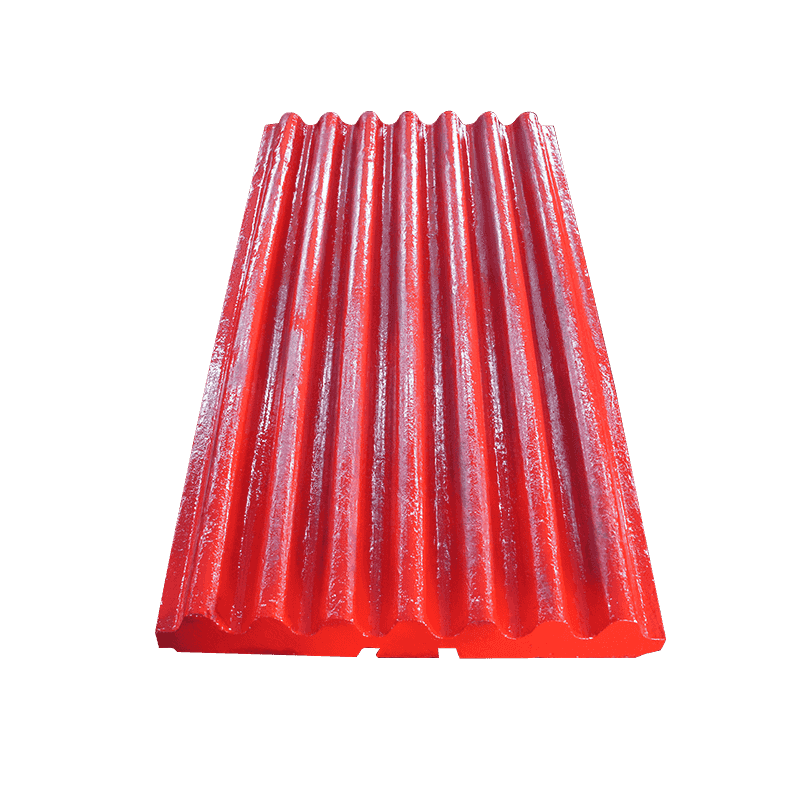
The corrugated surface of a jaw plate — alternating ridges and valleys across the crushing face — serves multiple functions that are often not fully appreciated:
- Grip and fracture initiation: The ridges create stress concentration points on the rock surface, initiating fracture at lower compressive loads than would be required on a flat plate. Well-designed ridge geometry improves crushing efficiency and reduces specific energy consumption.
- Wear distribution: Corrugations distribute wear across a larger surface area than a flat plate. As ridges wear down, the contact area increases, distributing load more evenly and slowing the wear rate through the plate's life — a self-compensating effect that extends service life compared to flat plates.
- Material flow control: The ridge pattern guides material flow through the crushing chamber, preventing packing in the upper chamber that causes power spikes and premature tramp iron damage.
Ridge pitch (the distance between adjacent ridge peaks) is typically 50–100mm for primary crushers processing large feed, reducing to 30–60mm for secondary applications. Ridge height of 30–50mm on new plates degrades to near-flat at end of useful life — monitoring ridge height is a reliable method for assessing remaining jaw plate service life without removing the plate from the crusher.
Wear Patterns on Fixed Jaw Plates: What They Reveal About Crusher Operation
The spatial distribution of wear on a removed fixed jaw plate is diagnostic information about the crushing operation — not just a record of material loss. Understanding common wear patterns enables corrective action that extends the life of the next jaw plate set:
- Concentrated wear in the lower third of the plate: Indicates the crusher is being operated at a closed-side setting that is too tight for the feed material size — oversized material is packing the lower chamber and concentrating wear near the discharge. Open the CSS or reduce maximum feed size.
- Wear concentrated on one side of the plate: Indicates non-uniform feed distribution across the jaw width — material is entering predominantly from one side of the feed hopper. Correct feed chute geometry to distribute material evenly across the full jaw width, maximizing plate utilization.
- Rapid wear in the upper zone: Suggests feed material hardness exceeds the manganese steel's work-hardening capacity for the operating impact energy level. Consider a modified manganese grade (Mn14Cr2 or Mn18) or a bi-metallic jaw plate for the next replacement cycle.
- Uniform, progressive wear across the full plate: The ideal pattern — indicates correct feed distribution, appropriate CSS, and material-plate pairing. Simply replace at scheduled interval and continue with the same specification.
Reversing and Repositioning Jaw Plates to Maximize Wear Life
Most jaw plates are symmetrically designed to allow reversal — rotating the plate 180° to present the unworn upper section to the high-wear lower crushing zone. Systematic reversal of jaw plates at the midpoint of their service life consistently extends total plate life by 30–50%, as material that would otherwise be discarded as fully worn in the lower zone is moved to a lower-wear position where it continues to provide useful service. This practice is simple, adds zero material cost, and is the single most effective jaw plate life extension measure available to crusher operators.
Material Selection Guide: Matching Alloy to Application
The systematic selection of wear casting material requires honest assessment of two application variables: the abrasive hardness of the feed material (expressed as Mohs hardness or silica content) and the impact energy level of the crushing stage. These two variables, plotted against each other, define a selection matrix that guides alloy choice more reliably than rule-of-thumb recommendations.
| Application | Feed Material | Impact Level | Recommended Material | Expected Life Advantage |
|---|---|---|---|---|
| Jaw crusher jaw plate — hard rock primary | Granite, quartzite, basalt | Very High | Mn18 or Mn14Cr2 | Best toughness; work-hardening essential |
| Jaw crusher jaw plate — soft/medium rock | Limestone, sandstone | High | Standard Mn13 or Mn14Cr2 | Good balance; Cr addition improves initial hardness |
| HSI blow bar — secondary/tertiary | Limestone, sized feed <100mm | Moderate | Cr20 HCCI | 3–5× vs. Mn13; abrasion dominates |
| HSI blow bar — primary, large feed | Mixed rock, tramp risk | Very High | Mn13 or martensitic steel | HCCI fracture risk unacceptable |
| Cone crusher mantle/concave | Hard abrasive rock | Moderate–High | Mn14Cr2 or Mn18 | Work-hardening critical for inner mantle surface |
| VSI rotor tip — highly abrasive | Silica sand, granite | Moderate (high velocity) | Cr26 HCCI or WC inserts | Maximum hardness required at rotor tip |
| Slag crusher — high abrasion | Furnace slag, iron ore | Low–Moderate | Cr26 HCCI | Extreme abrasion resistance; low impact suits HCCI |
Casting Quality Assurance: What to Specify and How to Verify
The performance of crusher wear castings in service depends not just on the specified alloy but on the quality of foundry practice, heat treatment execution, and dimensional accuracy of the finished part. A jaw plate cast from correctly specified Mn13 but with inadequate solution annealing will fracture in the first days of service; a high chromium blow bar with internal shrinkage porosity will fail at the defect long before its expected wear life is reached. Specifying the alloy is necessary but not sufficient — quality assurance of the casting process is equally critical.
Chemical Composition Verification
Optical emission spectrometry (OES) analysis of a test coupon cast with each heat of metal is the standard method for verifying that the delivered casting meets the specified alloy composition. Key elements to verify and their tolerance ranges:
- For high manganese steel: Mn 11–14% (or grade-specific range), C 1.0–1.35%, Si maximum 1.0%, P maximum 0.07% (phosphorus embrittles manganese steel — this limit is critical and frequently violated in low-cost castings), S maximum 0.05%
- For high chromium cast iron: Cr within ±1.5% of nominal grade, C within ±0.2% of specification, Si 0.4–1.2%, Mn 0.5–1.0%, Mo (if specified) within ±0.1%
Hardness Testing Requirements
Hardness testing of finished castings provides the most accessible quality verification of heat treatment adequacy. Minimum hardness requirements and test methods:
- High manganese steel castings: Brinell hardness 180–220 HBN on solution-annealed surface. Values significantly above 220 HBN suggest incomplete solution annealing with retained carbides (harder but more brittle); values below 180 HBN may indicate composition deviation. Portable Leeb hardness testing on the casting surface before dispatch is acceptable for incoming QC.
- High chromium cast iron castings: Rockwell C hardness 58–68 HRC depending on grade and application (per Table 1). Test on ground spot on casting surface or on separately cast test block subjected to identical heat treatment cycle as production castings.
Non-Destructive Testing for Internal Defects
Internal porosity and shrinkage cavities are the most common casting defects in crusher wear parts and the most dangerous — they are invisible externally but act as stress concentration sites that initiate premature fracture. Non-destructive testing methods applicable to crusher castings:
- Ultrasonic testing (UT): The most effective method for detecting internal porosity, shrinkage, and inclusions in thick-section crusher castings. Should be specified for jaw plates above 80mm section thickness and for all blow bars and impact plates above 60mm.
- Magnetic particle inspection (MPI): Detects surface and near-surface cracks in ferromagnetic (manganese steel, martensitic steel) castings. Particularly important for checking weld-repaired areas and casting bosses where stress concentrations are highest.
- Visual and dimensional inspection: All castings should be inspected against dimensional drawings before dispatch. Jaw plate thickness at specified measurement points, jaw plate width and height, mounting hole positions and diameters — these dimensions must be confirmed against the crusher manufacturer's specification to ensure correct installation and jaw alignment in service.
Installation, Monitoring, and Replacement Scheduling: Maximizing Total Value from Crusher Wear Castings
The best wear casting specification delivers its full value only when combined with correct installation practices, systematic wear monitoring, and replacement scheduling that captures maximum material utilization without risking catastrophic failure of the casting or damage to the crusher structure.
Jaw Plate Installation Best Practices
- Correct backing compound application: Jaw plates must be backed with epoxy resin compound or zinc-based backing material to eliminate the gaps between the plate rear face and the crusher jaw that cause plate cracking from cyclic bending loads. Back compound mix ratio and cure time must follow the manufacturer's specification — under-cured or incorrectly mixed compound provides inadequate support.
- Torque-controlled clamping: Jaw plate retention bolts must be torqued to the crusher manufacturer's specified value and re-torqued after the first 8–16 hours of operation, as initial seating of the backing compound allows slight relaxation of bolt tension. Loose jaw plates rock against the jaw, causing fatigue cracking of the plate and fretting wear of the jaw surface.
- Parallel alignment check: After installation, verify that the fixed and swing jaw plates are parallel across the full jaw width at both the open and closed-side settings. Non-parallel jaw faces cause uneven wear and localized overloading that dramatically shortens plate life.
- Initial break-in operation: Run new jaw plates at reduced throughput for the first 4–8 hours of operation, allowing backing compound to fully cure under load and plates to seat against the jaw faces. Aggressive loading of new plates before seating is complete risks plate cracking at retention bolt holes.
Wear Monitoring and Replacement Timing
Replacing jaw plates and blow bars at the correct time — neither too early (wasting remaining material) nor too late (risking breakage damage to the crusher) — requires a systematic monitoring approach. Recommended monitoring practices:
- Measure and record jaw plate ridge height at three points (top, middle, bottom center) at every scheduled maintenance inspection. Plot against cumulative tonnes processed to establish wear rate and predict replacement date.
- Replace jaw plates when remaining thickness reaches the minimum safe limit specified by the crusher manufacturer — typically when ridges have worn flat and total thickness has reduced by 70–75% of original. Operating beyond this point risks plate fracture through to the retention bolt holes.
- Monitor blow bar weight loss by weighing a reference bar at each inspection — weight loss rate in kg/1,000 tonnes processed provides a consistent, material-independent wear rate metric that enables fair comparison between different alloys and suppliers.
- Schedule jaw plate replacement during planned maintenance windows, never reactively after fracture. Fractured jaw plates in service frequently damage the crusher jaw casting and adjacent components, turning a planned wear part replacement into a major unplanned repair.
Previous Post
What Are High Chromium Castings and How Do You Maximize Their Wear Life?
Next Post
Why Are Cone Crusher High Manganese Steel Castings the Preferred Choice for Harsh Mining Operations?
Related Products

-
- Phone:
-
+86 182 6058 7168
+86 (0)513 6890 5666
-
- Email:
- [email protected]
-
- Address:
- Wanghao Industrial Park, Haimen City, Nantong City, Jiangsu Province, China
-
- Media:

